
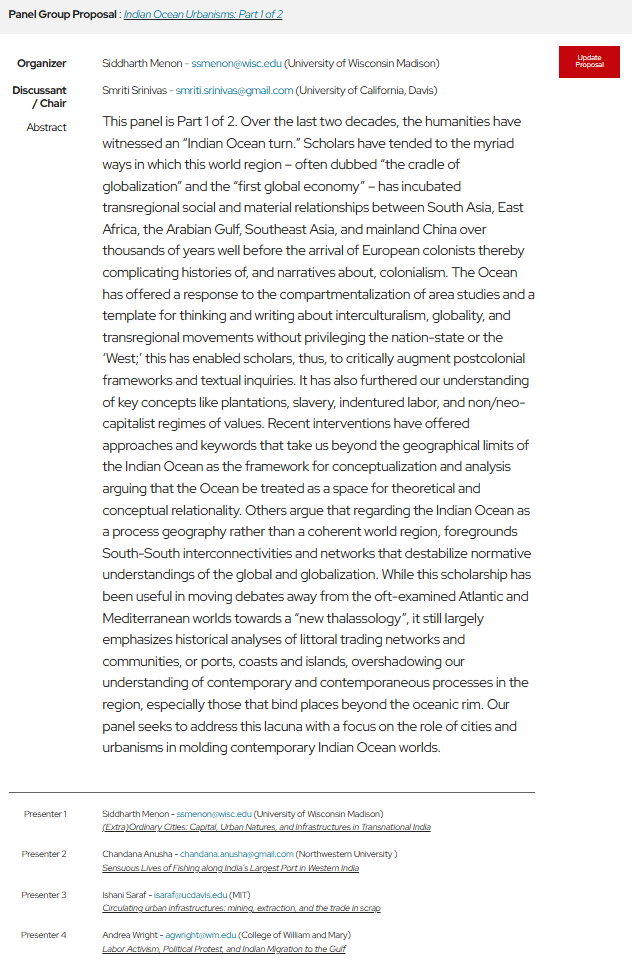
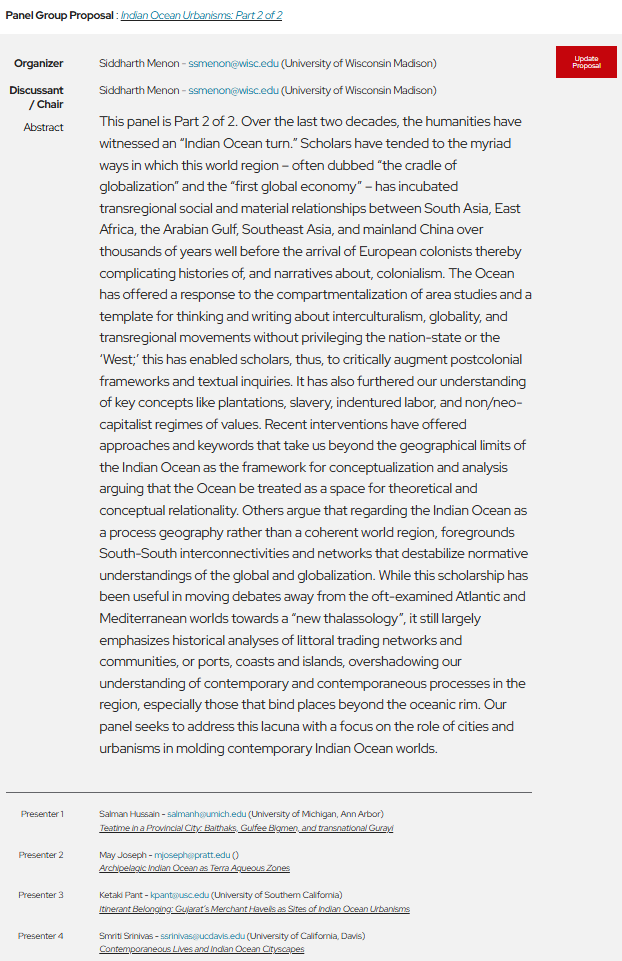
Dr. Smriti Srinivas and I organised a panel on “Indian Ocean Urbanisms” at the 54th Annual Conference on South Asia in Madison, Wisconsin on October 24, 2025. Many thanks to the participants for making this an engaging session (CFP below).
Indian Ocean Urbanisms
Organizers: Smriti Srinivas, Professor, Department of Anthropology, UC-Davis & Siddharth Menon, Assistant Professor of Urban Environmental Geography, Department of Geography and Environment, LSE
Over the last two decades, the humanities and the social sciences have witnessed an “Indian Ocean turn.” Inspired by the pioneering works of K. N. Chaudhuri, Abdul Sheriff, Frank Broeze, Janet Abu-Lughod, Abdulrazak Gurnah, and Amitav Ghosh, scholars have increasingly tended to the myriad ways in which this world region – often dubbed “the cradle of globalization” and the “first global economy” (Campbell 2008) – has incubated transregional social and material relationships between East Africa, the Arabian Gulf, South Asia, Southeast Asia, and mainland China over thousands of years well before the arrival of European colonists (Amrith 2015; Alpers 2013) thereby complicating histories of, and narratives about, colonialism (Bose 2009). The Ocean has offered a response to the compartmentalization of area studies and a template for thinking and writing about interculturalism, globality, and transregional movements without privileging the nation-state or the ‘West;’ this has enabled scholars, thus, to critically augment postcolonial frameworks and textual inquiries (Abusharaf et al. 2023; Ho 2014; Hofmeyr 2012). It has also furthered our understanding of key concepts like plantations, slavery, indentured labor, and non/neo-capitalist regimes of values (Campbell 2004; Subramanian 1996). Recent interventions have offered approaches and keywords that take us beyond the geographical limits of the Indian Ocean as the framework for conceptualization and analysis arguing that the Ocean be treated as a space for theoretical and conceptual relationality (Srinivas et al. 2020). Others argue that regarding the Indian Ocean as a process geography rather than a coherent world region, foregrounds South-South interconnectivities and networks that destabilize normative understandings of the global and globalization (Menon et al. 2022; Roberts 2000).
While this scholarship has been useful in moving debates away from the oft-examined Atlantic and Mediterranean worlds towards a “new thalassology” (Vink 2007), it still largely emphasizes historical analyses of littoral trading networks and communities, or ports, coasts and islands, overshadowing our understanding of contemporary and contemporaneous processes in the region, especially those that bind places beyond the oceanic rim (Srinivas et al. 2020; Srinivas 2022). Our panel seeks to address this lacuna with a focus on the role of cities and urbanisms in constituting and molding contemporary Indian Ocean worlds. It asks:
- How are historical interconnectivities across the Indian Ocean being restructured and reworked in contemporary urban sites?
- How is rapid growth of Indian Ocean cities creating new kinds of transregional interdependencies or mobilities across the wider Indian Ocean world?
- What kinds of environmental vulnerabilities/relationalities are created in the age of climate change due to urban development processes in Indian Ocean worlds?
- What are the modalities through which various hopes, desires, memories and religious/cultural imaginaries are articulated with contemporary Indian Ocean cities?
- Can a focus on Indian Ocean worlds help us reconceptualize the city and urbanism in contemporary South Asia?
- How does a focus on urbanisms in Indian Ocean worlds engender new ways of framing “South Asia” and its study?
 Siddharth Menon